February & March Book Roundup 2020

books feb 2020

I’m not sure I’ve ever experienced two months quite like February and March of this year. The world has changed so quickly, and now it feels like my normal life has come to a stop. Finding my new normal has been a challenge, but I’m grateful because if managing a new routine is my worst problem then I’m a very lucky person. In the spirit of staying positive, one of the best things that has come of this for me is that I have much more time to spend reading, so here’s a breakdown of everything I’ve read since January.

The Red Daughter by John Burnham Schwartz

This is a fictionalized account of Svetlana Alliluyeva’s life. Stalin’s youngest child and only daughter, she defected to the US in 1967. This narrative covers her experiences as she tries to find her way in a new country while also trying to maintain a connection with her past and the children she left behind in the Soviet Union. Spanning decades, the novel follows her relationship with the lawyer who helped to navigate her initial escape. I enjoyed this novel but I didn’t love it; at times it felt like it dragged on. I also didn’t like the way Svetlana’s character was portrayed which made it hard to love.

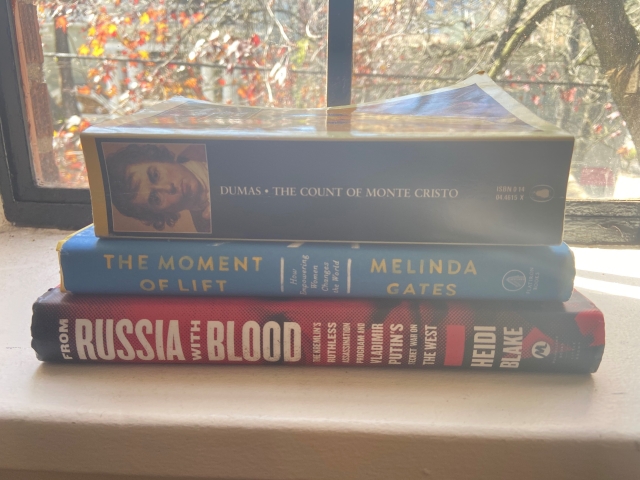
From Russia With Blood by Heidi Blake

Another Russia focused book! This one was a riveting nonfiction read. It covered a series of state-ordered attacks on Russian enemies in foreign countries, focusing mainly on Great Britain. These murders were committed via stealthy poisons that made deaths look accidental or health related. Despite mounting evidence that showed Russia (and the Kremlin) was behind the attacks, the UK and US governments refused to acknowledge the deaths as murder which eventually led to their own civilians being potentially harmed. This was an eye-opening book on recent history and foreign politics; it was both thrilling and terrifying to read.

Patsy by Nicole Dennis-Benn

Patsy is a single mother in Jamaica who dreams of living in the United Sates. Led on and encouraged by her best childhood friend, she leaves behind her daughter to move to New York in hopes of a better life. Once there, she faces the cruel reality of life as an undocumented immigrant and the realization that her friendship isn’t what she imagined it would be. The novel follows both Patsy and her daughter as they grapple with her decision and the impact it has on both of their lives. I enjoyed this novel, but I did feel that there were some side plots that weren’t fully explored. These plots took time away from the main story, and I would have preferred to explore the main story in more depth.

The Starless Sea by Erin Morgenstern

I’ve had this book on hold from the library since its publication date in November and I was happy to finally get a chance to read it. Many of my bookish friends were disappointed with this one, so I went into it expecting it to be subpar. I’m not sure if we just have different tastes or if having low expectations allowed me to enjoy it more, but I liked this book. There were many different storylines and characters to keep track of, which sometimes was hard to do, but I liked the mystery of piecing everything together. It was a fantasy novel set in a world of books, what could be better?

The Moment of Lift by Melinda Gates

“Our call is to lift women up – and when we come together in this cause, we are the lift.” In this book, Melinda Gates shares the lessons and stories she’s learned from people around the world whom she’s met as part of her work with the Bill & Melinda Gates Foundation. In an effort to find solutions for the world’s most vulnerable populations, Melinda (and the foundation) began to see that empowering women is the key to improving societies and has the power to change the world. She shares data and statistics alongside inspiring and heartbreaking stories, and even includes details from her personal experiences as a woman, wife, and mother. While some of the stories were devastating to read, the overall message of empowerment carried through. This book opened my eyes in some ways and broadened my understanding in other areas. It was both an uplifting take on how far we’ve come but also a stark reality on how far we still have to go.

The Count of Monte Cristo by Alexandre Dumas

Sometime during the past few years I’ve realized that I haven’t read much classic literature. AP English could only cover so much, and I was a business major in university so there’s a lot of recommended reading that I’ve missed out on. In an effort to correct that I’ve tried to include a few classics in my yearly book lists, and The Count of Monte Cristo was the most recent. In my last post I shared more details about how much I loved this novel, so here I’ll just say it was one of the best things I’ve read in a long time.


Next up…

I’m so excited about the books I have coming up in my to-read pile! Travel might be impossible due to current events but books will be taking me to Spain, Chile, Costa Rica, Russia, and different regions in the US. I can’t wait to share more details!
 

January 2020 Book Roundup

books2

The beginning of the year is always a time to reflect on the previous year and set intentions for the new year, but as usual I’m a little late to that party. I do know how many books I read in 2019 (38) and that only a fraction of them were nonfiction (25%), and both of those numbers mean that I missed my targets (40 and 50% respectively). But the fun thing about reading is that it’s a hobby so it doesn’t matter at all what those numbers are! The only downside to reading fewer books is that my to-read list has grown exponentially faster than the number of books I’m capable of finishing; my list spreadsheet is currently sitting at 351. Oops.

On the upside, I started off strong in January and finished 5 books! This is thanks in part to being sick over a weekend and spending a solid chunk of time on airplanes last month, but I’ll take the win. On top of that, three of them were nonfiction, so if I keep up this trend then I will surpass my goals from last year. I guess we’ll see how long this momentum lasts…

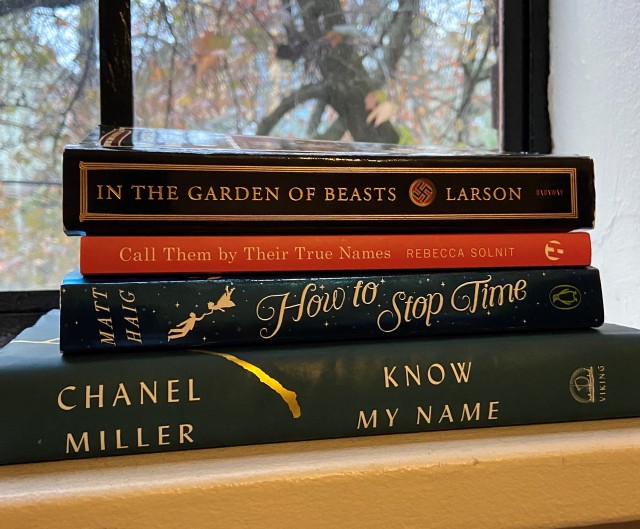
Anyway, my first book of 2020 was In the Garden of Beasts by Erik Larson. Larson has a special place in my bookworm heart because his The Devil in the White City was the first nonfiction book that I absolutely loved. Thanks to him I had the courage to step out of the familiar literature section of the bookstore, and it’s been an amazing journey ever since. Unfortunately, I didn’t love Beasts as much as White City, but I found it an interesting albeit dark read. It follows a year of events in Berlin starting in 1933, with the focus centered on the US ambassador to Germany and his adult daughter. From a history perspective, it provided more details on specific events and attitudes of various people in the beginning of Hitler’s rise to power. It was eerie to read some of the accounts when I knew what hell and horror awaited the world over the next ten years, but that dark edge is what I enjoyed most in the book. What I didn’t like was that a lot of the source material was based on journals, letters, and unfinished manuscripts, so I felt like I had to read everything with a critical eye and that there might be more to the story that I was missing. Maybe that’s just a byproduct of living in the fake news era, or maybe that just means I’ve grown to be a more critical reader. Also, I didn’t care for the ambassador’s daughter. Had I been alive in 1933 I’m pretty sure we would not have been friends.

Moving on to (fictional) people that I would want to be friends with, my second book of the year was The Giver of Stars by Jojo Moyes. I really enjoyed this book, which was surprising to me because I was expecting it to be a bit of a dud after all the press it received ahead of publication. It follows a small group of women who run a mobile library in the backwoods of Kentucky, despite facing personal hardships and ire from many of the people in their community. The plotline was a bit much (it covered everything from marital problems and illegitimate children to natural disasters and racy courtroom trials) but the characters at its heart made it worthwhile. I think each of the women, but especially Alice and Margery, were very well flushed-out and felt like they could be real people. I felt connected to their challenges and was totally invested in wanting to know how their stories ended.

Third on my list was Call Them by Their True Names by Rebecca Solnit. This collection of essays fell a little flat for me, but I think that was based more on my attitude and interest rather than the quality of writing. I had been so looking forward to reading this in December, but by the time I started it in January I wasn’t as into it. I enjoyed how Solnit presented her views; she discusses the linguistics of the Trump era and challenges incorrect uses of language to highlight problems in our current society. However, I found myself skimming some of the essays rather than really reading them. I just didn’t feel drawn to what I was reading in the way I thought I would. I think I’ll pick this collection up again at some point in the future, I want to give it a fair shot when I’m more in the mood for this type of content.

Next up on my reading list was How to Stop Time by Matt Haig, which was a little out of left field for me. This is one of those rare books that magically appeared in my life without ever landing on my epic to-read list. I found it in the laundry room in my apartment building. There’s an area where people sometimes leave unwanted items (pots, fans, old Christmas decorations, etc.) and one day I saw a book on the pile. I grabbed it without really looking at it, and it’s been sitting on my shelf for months. When I was sick for a few days I wanted to read something light and fluffy, so I picked it up again. It’s about a man who ages incredibly slowly- he was born in the 1500’s but looks to be about 40 in the 21st century. He’s part of a society of people like him, and their purpose seems to be to live, keep their lives secret, and limit interactions with regular humans. The novel covers his growing disillusionment with the society, his inner conflict about a potential love, and his desperate attempt to find his daughter from his first marriage in the late 16th century. It was a fun sci-fi/romance/history hybrid and was the perfect light read for a sick day.

The last book I read in January was anything but light, but it was easily the best that I read last month and might be my best book of 2020 (yeah, I’m calling it early). The book was Know My Name by Chanel Miller, and damn did I feel things. Chanel was the woman who was sexually assaulted while unconscious by Brock Turner- you know, the piece-of-shit former Stanford student who was found guilty and convicted of sexual assault yet was only sentenced to 6 months in prison because apparently his skin color, wealth status, swimming accomplishments, and male gender made him more important than minimum recommended sentences for sexual assault felons. Chanel, known at the time only as Emily Doe, wrote a profound victim impact statement that was published on Buzzfeed and instantly went viral. I can remember reading it in my office at my old job and feeling like I was punched in the gut. She held nothing back. In many ways her book is an expansion on that original statement. My physical reactions were just as intense; I couldn’t read more than a chapter at a time because I had to get up and move around, try to let out the rage and despair that she had to experience this, that she’s not alone, that 1 of 6 American women are victims of rape or attempted rape, that there are millions of people right now at this very moment grappling with the same reality, and that again and again and again our society says that if you are a white male your life and future opportunities and value as a human being are worth infinitely more than a woman’s. It is impossible for me to accurately describe the undercurrent of fury buzzing through my veins, but Chanel does an amazing job of capturing her emotions and walking us step-by-step through her experience. I could probably go on forever about this book and how much it made me feel and how important her message is, but instead I’ll just end my rant and say that this should be required reading. It’s a fierce criticism of our society and the systems and processes that are designed to protect us but often fail, yet it’s also a personal and eye-opening account of triumph and hope.

Looking forward to February, there are a few Russia-related books on my radar, a novel about immigration and motherhood, a book on feminism and equality, and possibly a classic adventure novel if I’m able to maintain my current momentum. Cheers to 2020, it’s been off to a great start!


Favorite Books in 2019 (so far!)

books1

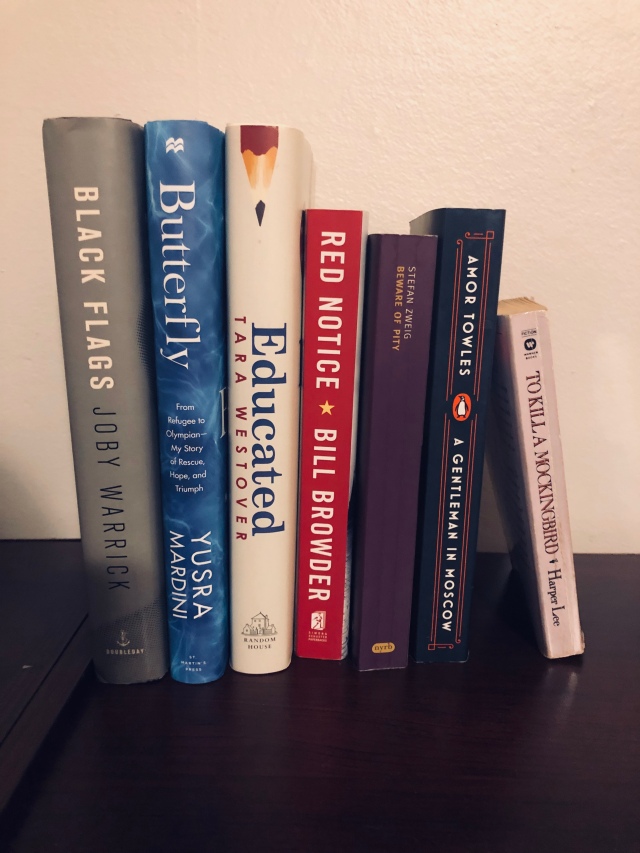
Somehow it’s autumn, and I don’t know where 2019 went. Or rather, I know where it went, I just don’t want to believe it’s almost over. This year has passed by in a montage of airplane windows, mountain views, sunset walks, 6am meetings, indulgent dinners, countless beers, and yes- a number of books enjoyed from my couch, a park bench, and hotel rooms all over the world. But now it’s fall- my favorite season full of all the best things in life: cozy sweaters, apple cider, pumpkin beer, ankle boots, colorful leaves, and red wine. Keeping in the spirit of all my favorite things, I’m sharing the top ten books that I’ve read so far in 2019 (and a few honorable mentions because I’m incapable of limiting myself).

  1. A Gentleman in Moscow by Amor Towles

This book was on my radar for a long time, and I finally read it in July. Months later, I still feel haunted by this novel. The story and characters have stayed with me, I can’t shake them from my head. Much of this book took place in the confines of one hotel in Moscow, but the themes and emotions it inspired go far beyond building walls and the pages that contained them.

  1. Silver Linings Playbook by Matthew Quick

On a rainy Friday night in March I treated myself to a Bradley Cooper movie marathon, and Silver Linings Playbook was part of the lineup. Watching the movie again reminded me of how much I enjoyed the book, and so I decided to reread it. It’s a beautiful story that explores relationships and mental illness; it’s equal parts endearing, heart-wrenching, and at times comical. Pat, the main character, is so engaging that you can’t help but root for him to succeed, even if you know what he’s doing is ill-fated. (And, of course, it doesn’t hurt to have a certain attractive, blue-eyed actor as the mental image of the main character.)

  1. Red Notice by Bill Browder

Another book that haunted me, but this one is a true story. It’s a combination of high-stakes business, international law, Russian politics, and ultimately the global fight for justice for a man wrongfully imprisoned and killed. The events in this memoir read like a James Bond novel, and it was sobering to remember that it was all real. This was also one of the first nonfiction books that I’ve read that has mainly taken place during my lifetime, and it was disturbing to picture where I was and what I was doing at the time of some of the more horrific events in the book.

  1. Beware of Pity by Stefan Zweig

This book started out slow for me, but once I was hooked I couldn’t put it down. After an embarrassing first encounter with a crippled girl, a young lieutenant takes pity on her and begins a friendship. She misinterprets his interest as romance, and he plays along to keep her happy and in good health. His actions are kindhearted in intent but cruel in practice, and they get worse as he finds himself more and more entangled with her family. This was a brilliant exploration of compassion and human nature set against the backdrop of pre-World War I Austria-Hungary.

  1. Butterfly by Yusra Mardini

This was a moving memoir, beautiful in its simple and direct style but heartbreaking in the events described. Yusra tells the story of her childhood in Syria, and her dreams of becoming an Olympic swimmer. As she enters her teens she describes the gradual yet devastating way that war took over her normal life, and how her family made the unimaginable decision to flee to Germany. Their journey was difficult, terrifying, exhausting, and very nearly fatal. As Yusra goes on to eventually compete in the 2016 Olympics on the refugee team, she reflects on what it means to be a refugee and have that word thrust upon you by a world that seems determined to use it against you.

  1. To Kill a Mockingbird by Harper Lee

Rereading To Kill a Mockingbird always feels a little bit like going home. I love Scout as a character, she reminds me a little of myself when I was younger. The story is so familiar to me yet it never seems to bore me. Scout’s innocent perspective of a very mature and traumatizing situation not only makes Tom Robinson’s trial more “palatable” to read but it brings out the true injustice and unfairness of the case.

stockholm1
Blomkvist’s apartment overlooking Gamla Stan in Stockholm
  1. The Girl with the Dragon Tattoo by Stieg Larsson

I’ve loved this book since I first read it in 2012, and this year I had the wonderful experience of rereading it while in Stockholm, staying in an Airbnb just a few streets away from Blomkvist’s address! Never having been to Stockholm before I didn’t realize how much of the city makes it into the books, but within a few hours of walking around Södermalm all I wanted to do was read this book and find the real-life locations mentioned throughout. Thanks to my local library and the Libby library app I was able to satisfy this craving and virtually borrow the book from nearly 5000 miles away- technology is great!

  1. In the Heart of the Sea by Nathaniel Philbrick

This is the better, real-life version of Moby Dick. It’s more exciting, less wordy, and based on the disaster of the whale ship Essex that inspired the novel. It’s an amazing tale of survival, and an interesting piece on early American history. I expected it to be dry and boring, but I was captivated. It had my book club talking for months!

  1. Educated by Tara Westover

This was an eye-opening memoir that made me feel truly grateful for my own family, upbringing, and opportunities for education. Growing up off the grid in rural Idaho, Tara Westover didn’t set foot in a classroom until she was seventeen. It was amazing to read of how she came to grips with her family and the unconventional way that she grew up while also accepting that she has every right to the education and accomplishments she has earned thus far in her life.

  1. Into Thin Air by Jon Krakauer

This is unofficial required reading for anyone interested in mountaineering and travel. This is Krakauer’s account of the 1996 disaster on Mt. Everest that claimed eight lives, and until 2014 was the deadliest year on the mountain. I think it’s brilliant how he captured the essence and personalities of his fellow climbers while also showcasing the physical, mental, and emotional toll that summiting Everest entails. It was clear that he was still reeling from the disaster as he wrote the book, and I appreciated his honesty in admitting his mistakes and regrets.

Honorable mentions…

Miracle Creek by Angie Kim

This is Angie Kim’s debut novel, and I was very impressed with it. She really brought the characters to life and made them real people with believable thoughts and actions. I can’t say I’m happy with how the novel ended, but I loved the way the story was told.

Black Flags: The Rise of ISIS by Joby Warrick

This was another eye-opener for me. Despite all the CNN that my mom watched when I was a teen, I’m disappointed to admit that I didn’t know a lot of what was discussed in this book. Warrick researches the people and events that led to the founding of ISIS. He highlights decisions and mistakes that were made for the sake of politics- in both the US and Middle East. It’s sad to look at the state of things today and wonder if the situation could be any better if only a few different choices were made.