January 2020 Book Roundup

books2

The beginning of the year is always a time to reflect on the previous year and set intentions for the new year, but as usual I’m a little late to that party. I do know how many books I read in 2019 (38) and that only a fraction of them were nonfiction (25%), and both of those numbers mean that I missed my targets (40 and 50% respectively). But the fun thing about reading is that it’s a hobby so it doesn’t matter at all what those numbers are! The only downside to reading fewer books is that my to-read list has grown exponentially faster than the number of books I’m capable of finishing; my list spreadsheet is currently sitting at 351. Oops.

On the upside, I started off strong in January and finished 5 books! This is thanks in part to being sick over a weekend and spending a solid chunk of time on airplanes last month, but I’ll take the win. On top of that, three of them were nonfiction, so if I keep up this trend then I will surpass my goals from last year. I guess we’ll see how long this momentum lasts…

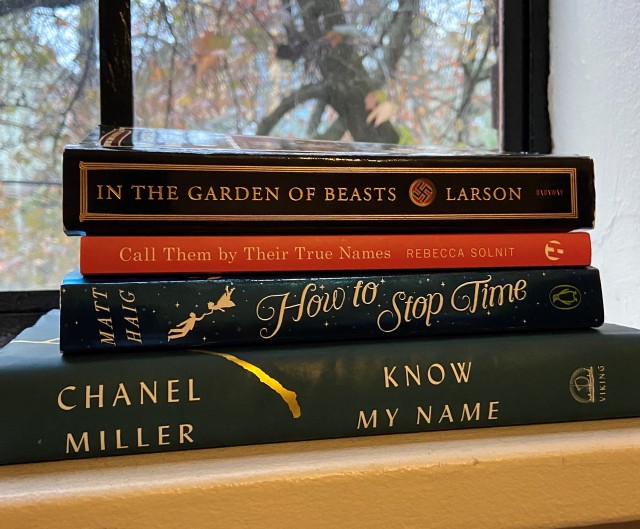
Anyway, my first book of 2020 was In the Garden of Beasts by Erik Larson. Larson has a special place in my bookworm heart because his The Devil in the White City was the first nonfiction book that I absolutely loved. Thanks to him I had the courage to step out of the familiar literature section of the bookstore, and it’s been an amazing journey ever since. Unfortunately, I didn’t love Beasts as much as White City, but I found it an interesting albeit dark read. It follows a year of events in Berlin starting in 1933, with the focus centered on the US ambassador to Germany and his adult daughter. From a history perspective, it provided more details on specific events and attitudes of various people in the beginning of Hitler’s rise to power. It was eerie to read some of the accounts when I knew what hell and horror awaited the world over the next ten years, but that dark edge is what I enjoyed most in the book. What I didn’t like was that a lot of the source material was based on journals, letters, and unfinished manuscripts, so I felt like I had to read everything with a critical eye and that there might be more to the story that I was missing. Maybe that’s just a byproduct of living in the fake news era, or maybe that just means I’ve grown to be a more critical reader. Also, I didn’t care for the ambassador’s daughter. Had I been alive in 1933 I’m pretty sure we would not have been friends.

Moving on to (fictional) people that I would want to be friends with, my second book of the year was The Giver of Stars by Jojo Moyes. I really enjoyed this book, which was surprising to me because I was expecting it to be a bit of a dud after all the press it received ahead of publication. It follows a small group of women who run a mobile library in the backwoods of Kentucky, despite facing personal hardships and ire from many of the people in their community. The plotline was a bit much (it covered everything from marital problems and illegitimate children to natural disasters and racy courtroom trials) but the characters at its heart made it worthwhile. I think each of the women, but especially Alice and Margery, were very well flushed-out and felt like they could be real people. I felt connected to their challenges and was totally invested in wanting to know how their stories ended.

Third on my list was Call Them by Their True Names by Rebecca Solnit. This collection of essays fell a little flat for me, but I think that was based more on my attitude and interest rather than the quality of writing. I had been so looking forward to reading this in December, but by the time I started it in January I wasn’t as into it. I enjoyed how Solnit presented her views; she discusses the linguistics of the Trump era and challenges incorrect uses of language to highlight problems in our current society. However, I found myself skimming some of the essays rather than really reading them. I just didn’t feel drawn to what I was reading in the way I thought I would. I think I’ll pick this collection up again at some point in the future, I want to give it a fair shot when I’m more in the mood for this type of content.

Next up on my reading list was How to Stop Time by Matt Haig, which was a little out of left field for me. This is one of those rare books that magically appeared in my life without ever landing on my epic to-read list. I found it in the laundry room in my apartment building. There’s an area where people sometimes leave unwanted items (pots, fans, old Christmas decorations, etc.) and one day I saw a book on the pile. I grabbed it without really looking at it, and it’s been sitting on my shelf for months. When I was sick for a few days I wanted to read something light and fluffy, so I picked it up again. It’s about a man who ages incredibly slowly- he was born in the 1500’s but looks to be about 40 in the 21st century. He’s part of a society of people like him, and their purpose seems to be to live, keep their lives secret, and limit interactions with regular humans. The novel covers his growing disillusionment with the society, his inner conflict about a potential love, and his desperate attempt to find his daughter from his first marriage in the late 16th century. It was a fun sci-fi/romance/history hybrid and was the perfect light read for a sick day.

The last book I read in January was anything but light, but it was easily the best that I read last month and might be my best book of 2020 (yeah, I’m calling it early). The book was Know My Name by Chanel Miller, and damn did I feel things. Chanel was the woman who was sexually assaulted while unconscious by Brock Turner- you know, the piece-of-shit former Stanford student who was found guilty and convicted of sexual assault yet was only sentenced to 6 months in prison because apparently his skin color, wealth status, swimming accomplishments, and male gender made him more important than minimum recommended sentences for sexual assault felons. Chanel, known at the time only as Emily Doe, wrote a profound victim impact statement that was published on Buzzfeed and instantly went viral. I can remember reading it in my office at my old job and feeling like I was punched in the gut. She held nothing back. In many ways her book is an expansion on that original statement. My physical reactions were just as intense; I couldn’t read more than a chapter at a time because I had to get up and move around, try to let out the rage and despair that she had to experience this, that she’s not alone, that 1 of 6 American women are victims of rape or attempted rape, that there are millions of people right now at this very moment grappling with the same reality, and that again and again and again our society says that if you are a white male your life and future opportunities and value as a human being are worth infinitely more than a woman’s. It is impossible for me to accurately describe the undercurrent of fury buzzing through my veins, but Chanel does an amazing job of capturing her emotions and walking us step-by-step through her experience. I could probably go on forever about this book and how much it made me feel and how important her message is, but instead I’ll just end my rant and say that this should be required reading. It’s a fierce criticism of our society and the systems and processes that are designed to protect us but often fail, yet it’s also a personal and eye-opening account of triumph and hope.

Looking forward to February, there are a few Russia-related books on my radar, a novel about immigration and motherhood, a book on feminism and equality, and possibly a classic adventure novel if I’m able to maintain my current momentum. Cheers to 2020, it’s been off to a great start!
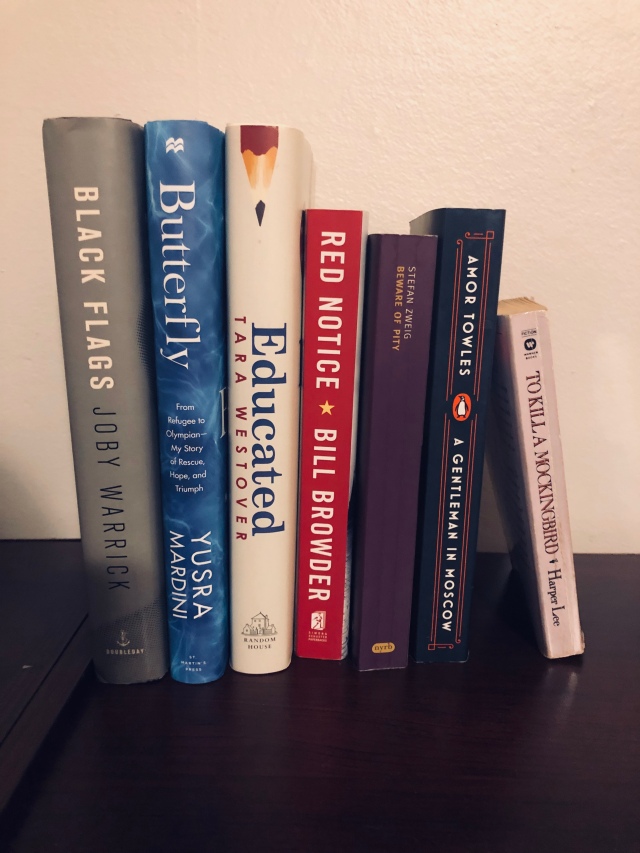
 

Favorite Books in 2019 (so far!)

books1

Somehow it’s autumn, and I don’t know where 2019 went. Or rather, I know where it went, I just don’t want to believe it’s almost over. This year has passed by in a montage of airplane windows, mountain views, sunset walks, 6am meetings, indulgent dinners, countless beers, and yes- a number of books enjoyed from my couch, a park bench, and hotel rooms all over the world. But now it’s fall- my favorite season full of all the best things in life: cozy sweaters, apple cider, pumpkin beer, ankle boots, colorful leaves, and red wine. Keeping in the spirit of all my favorite things, I’m sharing the top ten books that I’ve read so far in 2019 (and a few honorable mentions because I’m incapable of limiting myself).

  1. A Gentleman in Moscow by Amor Towles

This book was on my radar for a long time, and I finally read it in July. Months later, I still feel haunted by this novel. The story and characters have stayed with me, I can’t shake them from my head. Much of this book took place in the confines of one hotel in Moscow, but the themes and emotions it inspired go far beyond building walls and the pages that contained them.

  1. Silver Linings Playbook by Matthew Quick

On a rainy Friday night in March I treated myself to a Bradley Cooper movie marathon, and Silver Linings Playbook was part of the lineup. Watching the movie again reminded me of how much I enjoyed the book, and so I decided to reread it. It’s a beautiful story that explores relationships and mental illness; it’s equal parts endearing, heart-wrenching, and at times comical. Pat, the main character, is so engaging that you can’t help but root for him to succeed, even if you know what he’s doing is ill-fated. (And, of course, it doesn’t hurt to have a certain attractive, blue-eyed actor as the mental image of the main character.)

  1. Red Notice by Bill Browder

Another book that haunted me, but this one is a true story. It’s a combination of high-stakes business, international law, Russian politics, and ultimately the global fight for justice for a man wrongfully imprisoned and killed. The events in this memoir read like a James Bond novel, and it was sobering to remember that it was all real. This was also one of the first nonfiction books that I’ve read that has mainly taken place during my lifetime, and it was disturbing to picture where I was and what I was doing at the time of some of the more horrific events in the book.

  1. Beware of Pity by Stefan Zweig

This book started out slow for me, but once I was hooked I couldn’t put it down. After an embarrassing first encounter with a crippled girl, a young lieutenant takes pity on her and begins a friendship. She misinterprets his interest as romance, and he plays along to keep her happy and in good health. His actions are kindhearted in intent but cruel in practice, and they get worse as he finds himself more and more entangled with her family. This was a brilliant exploration of compassion and human nature set against the backdrop of pre-World War I Austria-Hungary.

  1. Butterfly by Yusra Mardini

This was a moving memoir, beautiful in its simple and direct style but heartbreaking in the events described. Yusra tells the story of her childhood in Syria, and her dreams of becoming an Olympic swimmer. As she enters her teens she describes the gradual yet devastating way that war took over her normal life, and how her family made the unimaginable decision to flee to Germany. Their journey was difficult, terrifying, exhausting, and very nearly fatal. As Yusra goes on to eventually compete in the 2016 Olympics on the refugee team, she reflects on what it means to be a refugee and have that word thrust upon you by a world that seems determined to use it against you.

  1. To Kill a Mockingbird by Harper Lee

Rereading To Kill a Mockingbird always feels a little bit like going home. I love Scout as a character, she reminds me a little of myself when I was younger. The story is so familiar to me yet it never seems to bore me. Scout’s innocent perspective of a very mature and traumatizing situation not only makes Tom Robinson’s trial more “palatable” to read but it brings out the true injustice and unfairness of the case.

stockholm1
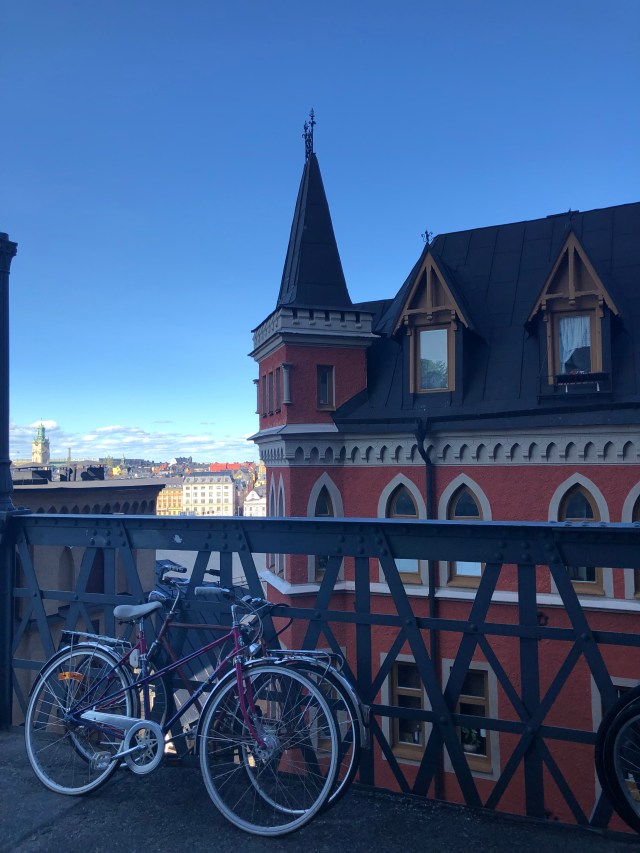
Blomkvist’s apartment overlooking Gamla Stan in Stockholm
  1. The Girl with the Dragon Tattoo by Stieg Larsson

I’ve loved this book since I first read it in 2012, and this year I had the wonderful experience of rereading it while in Stockholm, staying in an Airbnb just a few streets away from Blomkvist’s address! Never having been to Stockholm before I didn’t realize how much of the city makes it into the books, but within a few hours of walking around Södermalm all I wanted to do was read this book and find the real-life locations mentioned throughout. Thanks to my local library and the Libby library app I was able to satisfy this craving and virtually borrow the book from nearly 5000 miles away- technology is great!

  1. In the Heart of the Sea by Nathaniel Philbrick

This is the better, real-life version of Moby Dick. It’s more exciting, less wordy, and based on the disaster of the whale ship Essex that inspired the novel. It’s an amazing tale of survival, and an interesting piece on early American history. I expected it to be dry and boring, but I was captivated. It had my book club talking for months!

  1. Educated by Tara Westover

This was an eye-opening memoir that made me feel truly grateful for my own family, upbringing, and opportunities for education. Growing up off the grid in rural Idaho, Tara Westover didn’t set foot in a classroom until she was seventeen. It was amazing to read of how she came to grips with her family and the unconventional way that she grew up while also accepting that she has every right to the education and accomplishments she has earned thus far in her life.

  1. Into Thin Air by Jon Krakauer

This is unofficial required reading for anyone interested in mountaineering and travel. This is Krakauer’s account of the 1996 disaster on Mt. Everest that claimed eight lives, and until 2014 was the deadliest year on the mountain. I think it’s brilliant how he captured the essence and personalities of his fellow climbers while also showcasing the physical, mental, and emotional toll that summiting Everest entails. It was clear that he was still reeling from the disaster as he wrote the book, and I appreciated his honesty in admitting his mistakes and regrets.

Honorable mentions…

Miracle Creek by Angie Kim

This is Angie Kim’s debut novel, and I was very impressed with it. She really brought the characters to life and made them real people with believable thoughts and actions. I can’t say I’m happy with how the novel ended, but I loved the way the story was told.

Black Flags: The Rise of ISIS by Joby Warrick

This was another eye-opener for me. Despite all the CNN that my mom watched when I was a teen, I’m disappointed to admit that I didn’t know a lot of what was discussed in this book. Warrick researches the people and events that led to the founding of ISIS. He highlights decisions and mistakes that were made for the sake of politics- in both the US and Middle East. It’s sad to look at the state of things today and wonder if the situation could be any better if only a few different choices were made.


Alone Time by Stephanie Rosenbloom

IMG_2981

It’s been a year and a half since my last post, and a lot has changed in that time.  2017 was a rough year for me, mentally and emotionally.  I was unhappy with many aspects of my life- work, relationships, myself; and these feelings spiraled out of control on a few occasions.  In the fall of last year I think I hit my breaking point, and I made a few decisions that have since changed everything.  While the end of last year was spent preparing for these changes, 2018 has been about making them happen.  This year, I quit my job, I traveled solo through Chile and Peru, I moved across the country, I started a new job where I’m mentally stimulated daily, I’ve made amazing new friends, I’ve immersed myself in new experiences.  It’s been an exhilarating journey, and I’m now in a place where I’m extremely happy and simply loving life.

I’ve been wanting to restart this blog for the past few months, but if felt insignificant amid all the other changes in my life.  Though I’ve been reading more books than ever before (I’ve finished 38 so far this year) it seemed silly for me to write a post about a new release, a bestseller, a book club choice.  I wanted my return to this blog to mean something more.  And then I read Alone Time by Stephanie Rosenbloom.

In the book, the author discusses the benefits and enjoyment that can be found in solitude- whether that time alone is spent traveling or in the place you call home.  Told over four seasons in four cities (spring in Paris, summer in Istanbul, fall in Florence, winter in New York) she talks about being present, enjoying the moment, dining alone, embracing curiosity, feeling safe, and much more.  Interspersed among her own thoughts and experiences are references to other sources- both artists who reveled in alone time and psychologists who studied the benefits of it.  I was captivated by this book; as someone who had spent over a month traveling solo and then exploring a new city, it resonated with me on a personal level.  I felt like this book was written just for me, it couldn’t have found me at a more appropriate time in my life.

When I added this book to my Goodreads account I noticed a few negative and mediocre reviews, and at first I was worried that it would be a disappointing read.  However, after finishing the book I feel like those readers maybe didn’t understand the point of the book prior to reading it.  Alone Time isn’t meant to be a travel guide or narrative memoir (as some of the comments alluded to).  It’s meant to focus on how enlightening spending time by yourself can be.  It’s about the little details you notice when your attention isn’t divided between your surroundings and a companion.  It’s about savoring moments that are uninterrupted by aimless conversation.  It’s about learning to be comfortable by yourself- something many adults admit they struggle with.  It’s about embracing mindfulness and being present wherever you are, and finding peace in disconnecting from your smart phone for even just a few minutes.  It’s about embracing curiosity and the spirit of exploration, whether you’re wandering the streets of a foreign city or rediscovering a place at home that you haven’t visited in a while.

I especially enjoyed the last section, when she talks about New York in the winter.  New York is the place she calls home, and she talks about how over the years she had lost a sense of wonder and excitement about the city.  However, as part of her journey in this book and as a follow-up to her solo ventures abroad she makes an effort to explore New York with fresh eyes.  She began what she called tourist Tuesdays: days in which she went out of her way to go somewhere she hasn’t been or explore an attraction on her own.  If something piqued her interest she explored it, she started walking rather than taking the subway, she went to museums by herself.  This section gave me a different mindset on city living, and as I’m adjusting to my new home I’m taking this to heart.

I’m going out of my way to explore neighborhoods I haven’t been to yet, I’m making a point to visit some of the museums and tourist attractions in the area, and I’m taking time to just sit at an outdoor table and savor a drink while enjoying my surroundings without checking my phone constantly.  It sounds simple, but already those are things that have slipped past me in the months since I moved.  Reading Alone Time was a reminder for me to enjoy these moments and to not lose my sense of curiosity, and I’m looking forward to fully appreciating every bit of solitude that comes my way.  This book couldn’t have come at a more perfect time in my life, and I’m using it as the starting point for my next chapter.

Wild by Nature by Sarah Marquis

img_6190

I remember reading Wild by Cheryl Strayed a few years ago, and how I felt so in awe of her experience on the Pacific Crest Trail as well as her personal transformation over the course of her journey. I was inspired on so many different levels, and I remember researching the Pacific Crest Trail and the Appalachian Trail at the time. I remember that I thought I wanted to attempt one of them, at least until I realized I was already working full-time at that point and probably wouldn’t be able to support myself for so long without income. I like to think that because I’m a hiker and avid about the outdoors my inspiration was on a deeper level than the women portrayed on the Gilmore Girls revival A Year in the Life, but who knows. I’ve accepted the fact now that I probably won’t be doing any thru-hikes in my lifetime, and I’m okay with that. But the feeling of awe never really went away, and since then I’ve been drawn to books and memoirs by and about other PCT hikers, and Appalachian Trail hikers too (see my On Trails post here). When I stumbled upon Wild by Nature in the bookstore this past December, though, I think I was in shock.

It was one thing to spend a few months or a summer hiking a trail in one’s native country. It is a completely other (and in my opinion more monumental) thing to spend three years walking through some of the world’s most desolate landscapes in a journey that encompasses two continents! Not to mention the dangers that inhabit each of the countries Sarah Marquis wandered through, and the fact that this was all a completely solo expedition! She takes her love of the outdoors, and Earth overall, to a level that I had never encountered before. I couldn’t wait to dive into this book.

I started reading Wild by Nature on a plane on my way to Texas for a work trip. I was traveling with a male coworker who is in his sixties, and he noticed the book and asked to look at it. I handed it over, and he looked at the cover and glanced through some of the photos before giving it back. “Wow,” was his only comment. If you knew this man personally, you would understand that this is actually one of the highest compliments he can possibly bestow on anyone.

Marquis’ journey is incredible. She faced so many hardships throughout the expedition, but despite everything she remained positive and happy and so grateful about the experience. She walked through sub-zero temperatures and scorching heat, she faced down thieves on horseback and drug dealers, she battled dengue fever and tropic ringworm and a severe tooth abscess, and yet she continued her trek with an amazingly positive attitude. The distance and length of the expedition is awe-inspiring enough without the rough spots; she crossed over 10,000 miles on foot over the course of three years!

While reading the book, I think I was most inspired by her positive attitude, and I can’t say that enough. Many of the sections ended with Marquis offering up a grateful “Thank you, thank you…”. It provided me with a much better perspective on things in my own life. If she was able to continue the expedition and stay positive after dealing with some of the obstacles she faced, then I think it’s time I adopt a similar attitude for situations (not as intense) in my personal life.

I think when I started this book I was expecting more of an adventure story. While it does chronicle Marquis’ solo trek through the wilderness (which is indeed adventurous), I think I was more drawn to the spiritual and philosophical aspects of her journey. Marquis stressed the importance of a simple life tied to nature, and I think this book was a gentle reminder that I need a little more balance in my own life. Things have been crazy lately; I feel like I’m constantly jumping from one thing to another and it’s definitely been taking a toll. At one point in the book, Marquis talked about how your body knows what it needs and gives you signs to signal those needs; all you have to do is listen. I can’t help but draw parallels to my own life right now. I’ve been running, and admittedly stressing, almost nonstop since the holiday season. I kept saying that I needed to start slowing down and taking care of myself, but for January and most of this month I continued to ignore my own advice. So what did my body do? It threw a sinus infection and tendonitis at me, quite literally forcing me to take it easy and rest. And as odd as this may sound given my current condition, I actually do feel better!

As I’m reflecting on it now, I’m grateful that I read this book. It wasn’t quite what I expected but it was what I needed at this point in my life. Sarah Marquis is without a doubt an amazing individual, and I am truly inspired by her story. I’m looking forward to following her story on any future expeditions she challenges herself to.


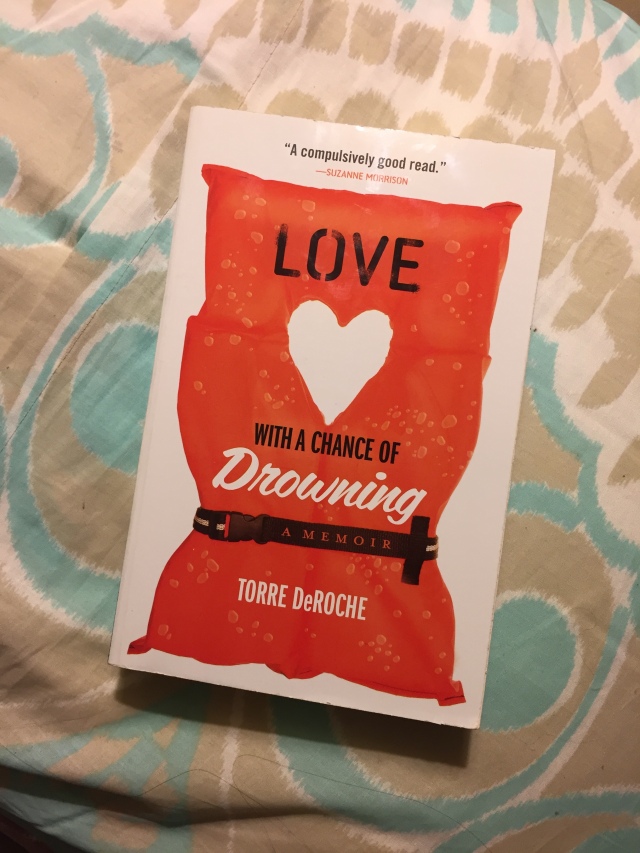
Love With a Chance of Drowning

img_5973

To be perfectly honest (and petty), I’m immensely jealous of Torre DeRoche after reading her memoir. Actually, if I’m going to be really honest I’ll say that I was immensely jealous about twenty pages in, and my envy only grew throughout the remainder of the book. I mean, she walks into a bar, approaches an attractive guy that just so happens to be a sexy Argentinean man, and not only does their drunken hook-up turn into a real, meaningful relationship but she ends up sailing halfway around the world with him! For me, personally, I would be completely and totally happy with about one of the above, let alone all of them! Torre DeRoche is one lucky woman, and I would do anything for her to show me her ways!

Okay, but all silliness and pettiness aside, I was very inspired by her story. And not just in the I-would-love-to-quit-my-job-and-travel-the-world way. Much of “Love With a Chance of Drowning” was about overcoming fears, or at the very least learning to live with them. And it was a very good examination of relationships, and how sometimes it’s not easy to reconcile the long term goals and dreams of two different people. Also, I think it was a good lesson on how to determine when you’re ready- for a move, for a job change, for whatever.

So in this book, Torre DeRoche tells the story of how she ended up sailing across the Pacific Ocean with her boyfriend, Ivan. Not only is this incredible by itself, but it’s made more incredible by the fact that Torre was very afraid of deep water. That’s right- a woman who was afraid of water spent two years sailing on the ocean! If that’s not the definition of overcoming fears, I don’t know what is. For Torre, the one thing holding her back was herself and her own trepidations. She talked a lot about how her experience was something she would tell her grandchildren about. Basically, she was presented with an opportunity of a lifetime, and she could either take advantage of it or turn it down because she was afraid. Obviously, she chose to embrace the adventure. But her fears didn’t end with her decision to go; her anxiety and stress were present throughout the book. Sailing across the Pacific Ocean sounds glamorous, but in reality it can be very dangerous. Over and over again Torre found ways to face down her fear and enjoy their adventure together, despite the risks. I think that was one of my favorite takeaways: you don’t have to be fearless to go on an adventure, you just have to be brave one day at a time.

Tied into Torre’s fears about the trip were her feelings for Ivan, her boyfriend. The relationship seemed to move at lightning speed: they met, then they were dating, within months they were living together, and almost within a year they were sailing the open seas together. I’ve had some experience being in a relationship that moves at hyper-speed, and in my case it didn’t work out. I had jumped in with both feet before I was ready to accept that his dreams were vastly different from mine. In my situation, he broke up with me because he was afraid that I wouldn’t be happy in the long run. It was brutal at the time, but looking back on the experience I think it was the right thing. I think I would have become miserable a few years in, and would have caused a lot more pain for everyone if it had continued. In a sense, Torre’s experience started out the same way. She committed to the trip knowing that Ivan had dreams of spending his life on the ocean. By comparison, she was a city girl with ties to civilization and people, and had plans to live out her life in Australia, her homeland. This dichotomy between the two of them was apparent throughout the book, and in some ways contributed to Torre’s stress and anxiety. It was proof that relationships aren’t easy, and that they often require sacrifice from both parties. This true story of a couple’s experience was evidence that love isn’t the fairytale that fiction pretends it is.

Aside from lessons on fear and relationships, I was most impressed with how and when Torre and Ivan knew it was time to let go and begin their journey. They had spent months living in the sailboat as it was docked in Los Angeles, and doing everything possible to prepare for their trip. For Torre, that meant learning how to sail as well as helping Ivan improve the boat so it was in its best condition. They received some frightening “advice” from some of the people they encountered. Sometimes they were told they would die at sea. Other times people said they were crazy and inexperienced, and it was too dangerous. But one woman told them that if they kept trying to prepare for the journey, then they would never leave. She said that it was impossible to ever be ready for such a trip, and it was just a matter of waking up and deciding to go. This stuck with me. It reminded me of a John Green quote from Paper Towns, which I’ll try to loosely quote here: “Leaving is the hardest thing to do, until you go. Then it’s the easiest damn thing in the world.” This quote, and Torre and Ivan’s experience, shows that we’re never really ready for what’s coming. There is no way to ever be completely prepared for what’s ahead. It’s just a matter of making a decision and sticking to it, and figuring it out along the way.

I wasn’t really expecting all of these important life lessons when I started reading this book. I was expecting it to be a light and comical read, without the philosophy lessons. However, I’m happy that these messages were there along with the humor. In a way, this was just what I needed to read at this point in my life, and I’m pleased that I had the notion to pick it up one day.

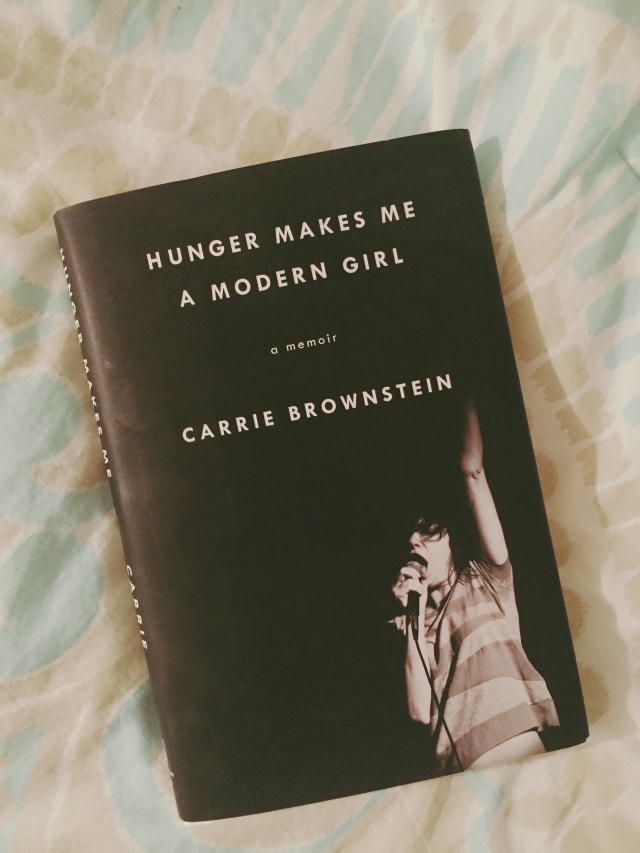
Hunger Makes Me a Modern Girl by Carrie Brownstein

Hunger Makes Me a Modern girl

To be honest, I couldn’t really get into this book. Partly it was because of the subject material, but I think my biggest issue is that I’ve had so much other stuff going on, and my interest just wasn’t there.  As I mentioned in my previous post, my vacation is coming up.  In fact- I leave for New York this afternoon and we fly to London tomorrow!  So needless to say, I’ve been rushing around and doing some last-minute shopping and attempting to pack and prepare for everything.  The trip has been the main thing on my mind, but I’ve also been busy with the young professional networking group I’m a part of, and I’m also trying to line up everything at work while I’m gone.  There were so many points over the past two weeks where I wanted to just stop reading this book and devote my energy to something else, but I promised myself I would finish it before I left.  So I pushed through.

I had never heard of Carrie Brownstein or Sleater-Kinney before, so I really had no idea what I would be reading about when Hunger Makes Me a Modern Girl was announced as the July/August book for Our Shared Shelf. Looking back at my progression through music, I think I was too young for the Riot grrrl movement and the whole indie-punk scene in general.  I was around seven years old when I got my first CD, which was the first Backstreet Boys album.  I spent the next few years in the mainstream pop music world, listening to not just Backstreet Boys but NSYNC, Britney Spears, and Christina Aguilera too (such a diversity).  My older brother might have listened to some punk bands, but his music never made it outside his bedroom or headphones or anywhere that I would be exposed to it.  In my early teens I started gravitating toward more “emo” bands, and the trend stayed throughout high school.  New Found Glory, Dashboard Confessional, Bowling for Soup, and Fall Out Boy were some of my favorites (enough so that I still listen to them today when I’m feeling nostalgic).  College was mostly about Top 40 and whatever was playing at bars and parties, and then after graduation I discovered Spotify.  Nowadays, I would say 50% of my music library is made up of singer-songwriter acoustic type artists, then split evenly between classic rock, country, electronic pop, and Top 40.  So, reading about a feminist punk rock band from the nineties was unlike anything I was familiar with.

The beginning part of the book, when Carrie talks about her childhood, I could relate to. She talked about putting on plays and performances for her family, and I kept smiling because I used to do that too.  My best friend and I always had a performance ready for our parents after sleepovers.  I think our best one was about two girls who lived by the beach.  The worst was when we created a band called Blue Ice, and our opening song was “We’re Blue Ice, we’re so nice, we’re Blue Ice and we’re so nice.”  The most entertaining one was the video we created of my Beanie Babies competing in a game show, complete with me using different voices for each contestant (this video still exists somewhere).  But then she started to grow older and had to deal with serious issues.  Carrie’s mother began suffering from an eating disorder, and as a reader you could see how that affected her.  Her life took a darker turn, and it was more difficult for me to relate to.

As Carrie described how music began to become more and more important in her life, I began to lose interest. She referenced bands I had never heard of, and feelings I had never experienced.  When she wrote about seeing bands live and discovering new music at record stores, I began to wonder if it was an age thing.  Would I be able to relate more if I had to hunt for good music, if it wasn’t as simple as opening an app on my phone?  And as for Sleater-Kinney’s experience touring and recording, I just couldn’t garner any appeal for it.  Sleeping on borrowed and possibly dirty mattresses, practicing in confined places that smelt bad, struggling to get by; it all repulsed me.  Maybe I’m too mainstream or protected or snobby (I seriously hope not) but I just couldn’t connect with it.

Despite all that, there were two important aspects of Hunger Makes Me a Modern Girl that I really enjoyed and appreciated. The first is Carrie’s complete openness about her struggles with depression and mental health.  It takes a certain kind of bravery to be that open and honest with the world, and I have so much respect for her.  I wish others (myself included) could be more open about our personal vulnerabilities.  In the world today, I think people are so exposed; there’s no break in attention.  It requires us to be “on” all the time, and it takes effort to maintain the image that’s out there, the image we want people to view us as.  So for someone to basically strip that image away and open up about such personal details, it’s amazing.

The second aspect that I appreciated were her thoughts on being a female musician, and why the word “female” shouldn’t really make a difference. A musician is a musician, regardless of gender, yet Carrie (and the other band members of Sleater-Kinney) faced countless questions about what it’s like to be a female musician, and they had to deal with so many gender stereotypes throughout the band’s career.  It’s frustrating.  As Carrie wrote in Chapter 15, “Anything that isn’t traditional for women apparently requires that we remind people what an anomaly it is, even when it becomes less and less of an anomaly.”  I mostly feel the same way about my job.  Being a woman in business is still something I have to explain; it’s like I have to constantly justify myself.  In reality, my job would be the same if I were a man, but it’s the perceptions and attitudes of others that make it different.

Despite my struggles connecting to Hunger Makes Me a Modern Girl, I’m glad I read it. So far, the books discussed in Our Shared Shelf have pushed me and expanded my knowledge about a number of different subjects.  This is definitely a book that I would never have considered reading if it weren’t for this book club, and I’m grateful for the opportunity to get outside my comfort zone and try something new.  And I’m happy to have learned about Carrie Brownstein and Sleater-Kinney.  I’m definitely planning on checking out the band on Spotify, and I’ll probably try to catch a few episodes of Portlandia as well.


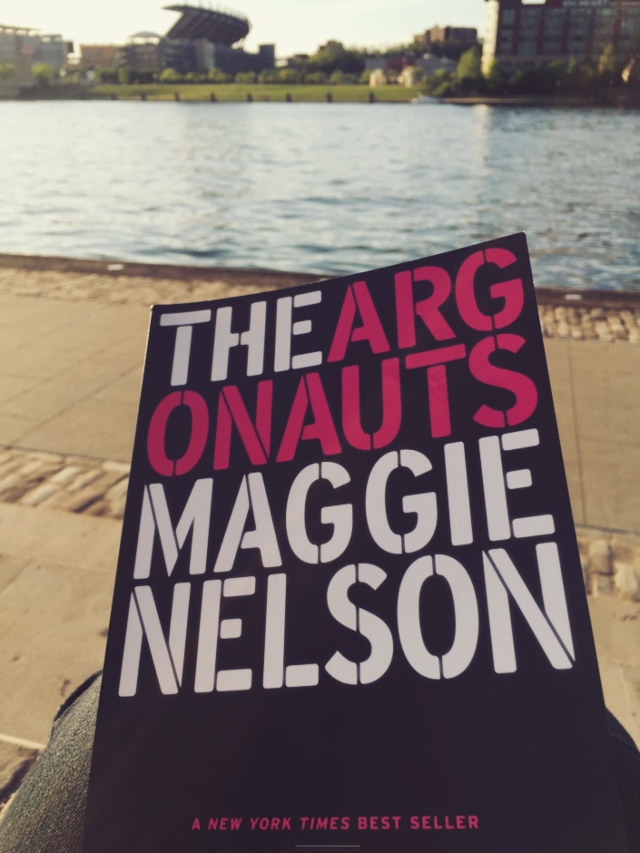
The Argonauts by Maggie Nelson

FullSizeRender(9)
Reading outside by the river!

The Argonauts was the May book choice for Our Shared Shelf. I was very excited to read it because it was so different from my normal reading material. If I had to describe what kind of book The Argonauts is, I would say that it’s a memoir blended in with essays on love, gender studies, and family (among many other topics!). It’s Maggie Nelson’s very personal account of her relationship with her fluidly gendered partner, and the experience of going through a pregnancy.

I struggled a lot with reading this book. I think it was a combination of the format and some of the subject material. The book is not divided into chapters, or any sections really. To me it reads like a stream of consciousness, with Nelson’s thoughts and insights and memories blending with references to theorists and scholars. Because there was no break throughout the book, I found myself becoming completely absorbed in her writing because it was very intense and powerful. But after 10 pages or so I would have to stop because it was so much information to take in, and I just needed a break. Also, I had to look up many of the references that she made, which made it a little more difficult and ultimately slowed my process. Overall, I think the book is very intellectually written, and I’m just not as familiar with some of the topics and references, and needed to get myself up to speed.

I think the thing that completely amazed me was how frank and honest Nelson was about such personal details of her and her family’s life. She held nothing back in writing this, she was herself openly and completely, regardless of opinions that others might have. I thought it was a beautiful piece of writing in that regard. That level of honesty is so rare, I felt very connected to what she was saying, and the experience kind of blew me away.

The Argonauts also expanded my awareness and understanding of gender fluidity. I haven’t had any experience with gender fluidity in my life, meaning that I don’t personally know anyone that would identify in that way. To be completely honest, I found it incredibly difficult to wrap my head around. I think the concept of “male” and “female” is so ingrained in my mind that I felt like I had to unlearn something, though I’m not exactly sure what it is that I unlearned. I just found myself questioning things a lot. For example, I was confused on what pronoun to use to describe Harry (Nelson’s partner), and eventually I reached a point where I was asking myself why I had to choose, and why couldn’t I just accept Harry as Harry and leave it be? This probably isn’t a good analogy because it’s so basic, but I remember telling people in high school that “I don’t believe in labels.” At the time I was referring to the loose classifications of preps, jocks, geeks, etc. I would tell people that I didn’t believe in labels because I felt like I belonged to more than one group. Is it such a stretch to apply the same logic to gender, even though the logic is so incredibly basic? I don’t know the answers to these questions, or even if there are answers. I’m just enjoying being challenged by the reading material. This is the first book in Our Shared Shelf that I felt motivated to participate in a discussion board, so it’s clear that the book is making me think. And however confusing or challenging that is, I like it.

Maggie Nelson also spent a significant portion of the book discussing motherhood, and how being a mother relates to and impacts being a woman. I thought these parts of the book were very interesting and eye-opening because it made me think about motherhood in a new light. I’m not a mom, and I have no plans to become one anytime soon, so a lot of the theories that Nelson discussed were basically unknown to me because motherhood just isn’t on my radar right now. It made me think a lot about my own mom, and some of my friends that have recently had children, and I wonder what they would think if they read this book. In that regard, I think they would have gotten more out of the reading experience than I did. I already want to re-read The Argonauts at some point, just because it is so much to digest, but I want to make a mental note to myself to pull this out if and when I ever have children. I wonder what I would think about it then.

Reading The Argonauts was definitely an experience. It was a struggle- both in the structure of the book and the subject material. Even though it’s only about 140 pages long, I was challenged enough that it took me over a week to read. But I’m not complaining about it. It was such an eye-opening book; it was just a really good learning experience. In a weird way, I’m kind of proud of myself for completing it. If it weren’t for Our Shared Shelf, I would’ve never felt compelled to read The Argonauts. It’s something I would’ve passed over in a bookstore without a second glance. So the fact that I went outside my reading “comfort zone” and that I finished it despite the struggle… it’s just a good feeling. It serves as a reminder to me that you can always learn by reading.

How To Be a Woman by Caitlin Moran

IMG_3047

How To Be A Woman was the April book for Our Shared Shelf. In the announcement post, Emma Watson said that she laughed out loud when reading it for the first time, and she meant it as a more light-hearted and entertaining read than some of the previous books. When I bought the book, the cover included a quote from VanityFair.com saying, “The British version of Tina Fey’s Bossypants.” Okay. I was sold.

Honestly, Moran is funny. And maybe slightly ridiculous, but I mean that in the best way. She is just so very… herself.   I think her personality really shines through. I would absolutely love to sit down at a bar and have a few rounds with her. Because not only is she hilarious, but she’s also wise (or at the very least she gives really, really good advice). I experienced a few “aha” moments while reading the book, and it has definitely made me question some things in my own life. Admittedly, though, there were a few topics that I found difficult to relate to, but for me that didn’t take away from the experience. If anything, it makes me want to re-read this book in a few years to see what more I will gain from it.

Moran begins the book by talking about her 13th birthday, and sharing thoughts she had at that time about what being a women meant, or what she felt she had to do to become one. Saying it like that sounds kind of ridiculous, but 13 is a confusing time, especially for girls. I think a lot of people would agree with that. But as Moran continues and discusses different topics concerning modern women (body hair, breasts, pornography, love, etc) she makes it clear through the telling of her own experiences that for women, growing up is a lot more than “finding yourself.” She points out over and over again all the different ways that society dictates how women “should” be. Ultimately, she reveals that the real learning experience was in figuring out how to block out all that noise, and just be her own person freely without judgment or consequence. Which essentially is how she goes on to define feminism in the fourth chapter: “What is feminism? Simply the belief that women should be as free as men, however nuts, dim, deluded, badly dressed, fat, receding, lazy, and smug they might be.” *applause*

One of the first chapters that really hit home for me was when she discussed encountering sexism at work. I can completely relate, and I understand the frustration of trying to figure out how to deal with it. Because, as Moran points out, the sexism encountered today in the modern workplace isn’t flagrantly obvious.   It’s subtle. It’s tricky. It makes you question yourself, “Was that really sexist? Or am I too sensitive? Is being sensitive giving into a predetermined role for a woman? Is calling sensitivity a female trait sexist? Am I sexist? I’m a woman how can I be sexist?!” I work in a corporate setting in a predominantly male environment (and a lot of these males are over 60), so I experience this kind of stuff daily and have learned to just shrug it off. It sounds crazy, but the flip side is filing a (probably embarrassing) report with HR that will be taken very seriously and might cause someone to lose their job, and is all of that really worth it just because of a few comments here and there? Because again, it’s never overtly sexist.   It’s mostly comments that are quite possibly intended as jokes, and I can take a joke right?

The very next chapter (about relationships) felt like it could have been written out of pages from my own diary, but it was also one that made me laugh a lot. My favorite part was when Moran discussed how so many women have imaginary relationships with men, and as she put it, “living in a parallel world in their head; conjuring up endless plots and scenarios for this thing that never actually happened.” I mainly enjoyed this because I am fully aware that I do this. Here is a summary of my most recent imaginary experience:

A couple of months back, I had been on a few dates with a guy when I saw on Facebook that he RSVP’d to a cocktail event that was about a month, maybe a month and a half away. And even though we had never actually discussed this event in person, I started thinking about buying tickets. Should we get the VIP tickets or go for the regular tickets? I thought VIP would be better, it included drinks so we could save money. And what about a dress? This would be our first public event as a couple, and someone would probably take pictures of us, so oh my god this is going to be our first Facebook picture together. Now, I absolutely had to buy a new dress, and probably new shoes too. I wanted to pick out a really nice dress, preferably a little sexy, because I’m relatively young and wanted this first picture to look Really Good. But it can’t be too sexy, because his mom will see it and I didn’t want her to think I was slutty. And while I was thinking of picking out a sexy-but-classy dress I thought I should plan on hitting the gym more just to make sure I look Really Good in this monumental picture, but I was going on a work trip the next week and visiting my brother out of town the following week, so how was I going to find the time?!  And I thought that I really should get my hair cut and maybe get my nails done too? Forget the VIP tickets, all of this costs money, and I’ve been trying to save up for vacation so maybe I should just plan on skipping some museums in London and then I won’t worry about spending the money now. And on and on I went, thinking all these crazy things, and the whole thing was pointless because he ended up not even going to the event! He was out of town that weekend!  And to top it all off- we aren’t even a couple!

Retrospective conclusion: I’m insane. But Moran made me feel like I wasn’t alone, and that it was perfectly normal for women to think things like this because society has such a negative opinion of single & unmarried women. I mean, if you’re a single woman I’m willing to bet you’ve been asked these questions more than a few times: When will you settle down? Don’t you hate living alone? When will you get married/have kids/start a family? Why are you single? Aren’t you afraid of becoming a crazy cat lady? Ugh… it’s all so annoying. Moran’s point was that there’s so much pressure out there on women when it comes to relationships, so it’s pretty natural that we go a little overboard when we think about them.

This was just one of the sections in the book that made me feel so understood. Like yes, this is what it’s like. This is what’s going through my head. I’m not alone, other women feel/think/do this too. Another chapter that I related to was when Moran discussed fashion and clothes, and how it’s about so much more than just picking out a shirt you like. She says, “How women look is considered generally interchangeable with who we are – and, therefore, often goes on to dictate what will happen to us next.” Basically, she’s saying that for women life is an elaborate game of dress-up where every day your clothes are just a costume for the person you’re supposed to be that day. For me, I could live in jeans and tee shirts (in the summer) and leggings and sweaters (in the winter). But at work I have to dress the part of Young Bright Professional Woman, so it’s all heels, skirts, and dresses. And heaven forbid I wear slacks and pull my hair back, coworkers might think I was out late the night before! (True story: I once wore slacks and pulled my hair back and my coworker asked if I was out drinking the night before. I wasn’t.) And if I go out at night, whether with friends or on a date I have to be the Cool Attractive Post-College Easygoing Woman Who Isn’t Trying To Be Cool And Attractive. For the record, I’m still trying to figure out how to pull that one off.

Basically, How To Be A Woman made me feel understood.  I could go on and on about everything that I related to, and how some of my experience were so similar to what Moran described.  There were some heavier topics in the book (children, abortion, etc) that I couldn’t relate to because personally I’m not there yet in my life, so I’m not ready to fully comment on those right now. But for the rest of the book, for all the chapters that I found relatable, including the topics I didn’t discuss here, reading felt like hanging out with a friend. Moran is funny, personable, and to me, relatable. I’m definitely looking forward to reading some of her other books, and I’m incredibly grateful to Emma Watson for introducing me to her.


When Breath Becomes Air by Paul Kalanithi

FullSizeRender

I don’t normally cry when I read; I can only think of three books that I’ve shed tears over in all my life. But when I heard about When Breath Becomes Air, and when I finally felt its weight in my hands, I expected tears to flow continuously while I read. I initially planned to read it on a plane on my way to New York for a weekend trip with a friend, but when I held the book and brushed my fingers over the title and Paul’s name, I knew that a plane wouldn’t do it justice. Even before turning the first page I knew that Paul Kalanithi deserved more than a short trip in a pressurized cabin; he deserved a quiet weekend afternoon with a cup of coffee and my oldest, favorite sweatshirt. He deserved my undivided attention, just me and the book and his words.  So I put it aside for another day, until I had the time (and courage) to give it my all.

To my surprise, I never did cry while reading the book. I think I was too focused on trying to take it all in and appreciate the message, I didn’t really allow myself to have an overwhelmingly emotional response. The tears seem more ready to come now as I try to talk about what this story meant to me, as I struggle to find a way to describe Paul and the story he so bravely shared. It’s not until now that I fully realize the irony that I think Paul was such an amazing and beautiful person, but it’s only through his death that I, along with millions of other people, came to know of him. He would have touched and changed and helped so many people had he lived to be the neurosurgeon he had trained to be, but he would have likely had no impact on my own life. It’s only through his death that I have come to know about his wise and beautiful mind, and I wonder if that is part of how we as a people think about the dead and dying. Don’t we always only focus on the good when our loved ones are gone? Will we all be better in death than we can ever hope to be in life?

One of the struggles that Paul talked about a lot was trying to figure out what to do with the rest of his days knowing that he had a limited, yet unknown, amount of time left. This topic intrigued me. Paul’s struggle was that he wanted to accomplish A, B, and C, but if someone could just tell him that he only had a certain amount of time left then he would jump straight to C and not worry about A and B. He just wanted to prioritize what would make him most happy in a given time period, and isn’t that what we all want to do? I mean, as morbid as it sounds wouldn’t it be easier to know when we will die?

Basic time management skills involve assigning an amount of time to certain tasks, and then prioritizing the most important tasks first. In a perfect world we could do that with our own lives; we could schedule everything that we want to do into the number of years we have, and we could die happy knowing that we accomplished all our goals and left no stone unturned. But we don’t live in a perfect world, and we can’t schedule every moment of our lives. And what we might lose in productivity I think we gain in beauty, because I believe the beauty in life lies in the unplanned moments, and the things we don’t expect that take our breath away.

Paul made me aware of my own mortality, and the reality that my life can turn on a dime and end up vastly different than anything I can imagine now. A few of the things I value in my life now seem trivial in the long run, but realistically I don’t know how long of a run I actually have. What if I receive similar news someday, what would I do with my life? How would I find meaning? These are questions that I find difficult to answer, which is frustrating. I have always been an advocate for living your best life and doing what makes you happy, so am I a hypocrite if I think I would change something if I thought I only had one year left?

Paul doesn’t answer these questions. He’s not as trivial or naïve as I am discussing them. He tells his story patiently and wisely, beautifully and bravely. In the forward, Abraham Verghese discusses feeling inadequate after reading Paul’s words, and I understand what he meant. I keep struggling to talk about this book; it’s hard for me to explain exactly what it meant to me. Verghese says in the last paragraph of the forward, “Listen to Paul. In the silences between his words, listen to what you have to say back. Therein lies his message.” I think this is a simple yet profound way of reflecting on Paul’s message. It’s not just about what Paul thinks and says, it’s about what you get out of it. It’s about what you feel and think after reading his story. It’s about how Paul has found a way to impact your life despite his untimely death. It’s about how your life may never be the same after reading his words.

What I Was Doing While You Were Breeding by Kristin Newman

IMG_2494
What I Was Doing While You Were Breeding by Kristin Newman (aka My Life Goals)

Reading this memoir was an inspiring yet terrifying experience. As a single 25-year-old female who loves to travel, I identified with Kristin. It was something about the way she wanted to do her own thing and see the world, but at the same time she wanted to find love (because that’s normal and what we’re supposed to do, right?!). In so many ways I felt like I was reading the memoir of some sort of alternate-universe version of myself, with the main difference being that Kristin is hilarious and I can only dream of being as funny as she is.

I felt the connection in the first chapter. “The first time I blew off steam internationally was not born of carpe diem. It was born of deep despair.” Add in the fact that Kristin’s deep despair was caused by a rough break-up and at that point in time she was only one year older than myself right now… well, it sounded eerily familiar. Her first international escape was with a friend, the friend’s boyfriend, and the boyfriend’s friend to Paris and Amsterdam. She spent an extra few days in Paris by herself, trying to be the Girl Who Has Fun Alone and, ultimately, she admitted that those days didn’t go as well as planned.

It was like reading a twisted version of my own journal. My first solo international experience was also born out of a break-up and the combination of a need to get away and the desire to be independent. Instead of just taking a trip to visit good friends in New York or Philadelphia (which probably would have been the sensible thing to do), I booked a solo flight to Munich for Oktoberfest. Why Munich? Because my friend’s Italian coworker was working there for a few months and had mentioned at one point that if any of us were in Germany we should let him know. I took that as a sign that I should go.  I had visions of myself breezing through the streets of Munich, sipping coffee and eating pretzels outside some gorgeous café, drinking liters of beer with attractive single foreigners from all over the world. You probably aren’t surprised that the trip didn’t live up to my expectations: I really struggled communicating in German, I found it difficult to meet people, I felt unsafe navigating through a bunch of drunk people by myself, and felt generally alone for a bigger chunk of time than I’d like to admit. However, I did manage to get a few things right: there was lots of great beer and good food, a hot Swedish guy made an appearance, I met some really cool people from Australia, and most importantly, I made it through an international trip all by myself and had an overall good time. Mission accomplished.


IMG_1700
Marienplatz in Munich, Germany

I drew all these parallels between my life and Kristin’s, and it was only the first chapter! As I continued reading, and learned about her adventures in Russia, Argentina, Australia, and more, I felt so inspired. I kept thinking to myself, this is what I’m going to do with my life. This is how I want to live. I started telling people that traveling was the most important thing, that I wanted to see the world, that I didn’t want to settle down, that I wanted to enjoy being single. (I didn’t tell them that I was almost quoting from a memoir that I was reading.) Kristin matured throughout the book; she became more self-confident and carefree when she was traveling. I kept picturing a future version of myself that was right there with her, just going with the flow and enjoying life, living each moment abroad to the fullest, not afraid of being judged. For the first time, I felt capable of achieving all of my lofty travel goals. If Kristin could do it, then so can I.

The last few chapters sobered me up a bit, though. Suddenly, the amazing and confident Kristin was in her late thirties, and afraid that she missed her chance at love because of all her adventures. The woman I had come to identify somewhat as a heroine was dealing with life questions that I can’t possibly understand at 25, and as I read her thoughts I realized I was afraid of the possibility of encountering the same problems. What if I traveled so much and focused on myself so much that I miss other opportunities? What if the adventures that I’m planning at 25 turn me into a crazy cat lady at 35? The last few chapters left me feeling nervous rather than adventurous, cautious rather than bold. By being honest about her thoughts and her life, Kristin presented the opportunity cost of being so independent and well traveled. But at the same time, she kept traveling and doing her own thing, which I found inspiring.

After finishing the book and letting it sink in for the past few days, I realize that I’m still inspired by Kristin’s life. She knew what she wanted and she went out to get it, and even though there were tough spots along the way she kept going, and along the way she met some amazing people and racked up countless stories to share. And in the end she regretted nothing, which to me is the most important thing.