Nine Perfect Strangers by Liane Moriarty

Nine Perfect Strangers was published in November of 2018.  Sometime before Christmas I placed a hold for the book at my local library.  Four months after that I nearly missed the email notification that a copy was finally available for me to borrow.  In the months since I placed the hold, I had veered away from mainstream new releases in fiction (I was tired of being led astray by good reviews only to be disappointed in writing quality and style) and instead was focusing on more nonfiction books, and returning to timeless old favorites in between.  I had forgotten what the book was supposed to be about, but a quick skim of the summary brought it back: nine strangers spend 10 days at a health retreat and face unexpected challenges.

In a lot of ways, this book is what I associate with typical Liane Moriarty: some kind of bizarre mystery, a dash of ridiculousness, a touch of humor, and a range of characters that are frustrating and endearing and sometimes one-dimensional.  Just like Big Little Lies, Three Wishes, and Truly Madly Guilty, I blasted through the book, determined to see what happened as fast as possible.  Moriarty knows how to hook me; a health retreat is just about the last setting in the world that I would want to delve into, but there I was on my lunch break, extending my time just so I could finish one chapter.  And the next, and the next one after that…  Beginning with the unfair confiscation of wine and chocolate and moving on to LSD smoothies and fire safety awareness, the health retreat went from annoying to sinister in just a few days.  I can honestly say I wasn’t prepared for the strange turn of events, so I have to hand it to Moriarty on a job well done of keeping me entertained.

However, the biggest thing I struggled with is something I’ve experienced while reading some of her other novels: there are just too many characters for me to feel a connection with.  Obviously in this book the writer Frances Pelty was intended to be the main protagonist, but there were eight other guests and three employees at the retreat that had histories and personalities of their own.  While the book explored all of them in some detail, it was hard to be deeply invested in any of their narratives.  The Marconi family experience and Masha’s backstory were probably explored the most other than Frances, but I would have loved to read more about Carmel’s evolution from businesswoman to mother (and caretaker and volunteer) and Lars’ family life, among others.  The most annoying characters by far were puppy-dog Yao and the Kardashian-wannabe Jessica; I would have loved to trade their plotlines for more details on ANY of the other characters.  I didn’t understand Yao’s character development at all, and Jessica’s was entirely unbelievable because I couldn’t understand how someone hadn’t slapped her in the face at any point in her life.

I also felt that some of the loose ends weren’t tied up in the last chapters.  While there was a general sense of ending (I don’t want to give away any spoilers here) it seemed like some characters had more detailed “epilogues.”  There were a few points mentioned in the last chapters that alluded to certain things happening, but there were several possible interpretations and I wasn’t sure which one was the intended plotline.

Even so, I did enjoy reading this.  It’s a fun book with twists and turns, and I was captivated until the end.  It had just the right balance of comedy and I was genuinely entertained.  I’m happy to say that Moriarty has yet to write a book that I dislike, and I can’t wait to see what she does next.


Circling the Sun by Paula McLain

FullSizeRender(3)

On any given day, there are a lot of things that can go wrong. You can spill coffee on your bare foot in the morning, or you can rear-end someone on your way to work. You can give your job everything you have but be let go without warning for reasons outside your (and maybe your supervisor’s) control. You can enjoy a lovely midsummer dinner with your partner only to have your heart broken when they tell you they don’t love you anymore. A family member that has been crucial to your life since the day you were born can suddenly betray and abandon you, seemingly without a care. Your universe can completely upend on a sunny afternoon when you get the call that your mother, or brother, or best friend, or any loved one has been taken from this world. On any given day, anything and everything can go wrong; but it’s what you do with this fact that determines the course of your life.

Beryl Markham learned this at a young age. Abandoned by her mother at the age of four, then catapulted into an unhealthy marriage at sixteen, Beryl was a seemingly modern woman born well before her time and forced to grow up way too soon. Born in England, her family moved to Kenya when she was very young. After her mother fled back to England, she was raised by both her father and the natives that lived on his estate. She was an unconventional wild child, and as an adult she never really found a way to fit into the mold of society. She made mistakes and muddled through them the hard way, yet she always seemed to make it through with her head up. She was an admirable woman; she built a career as a successful horse trainer, she learned to fly, she became the first female pilot to cross the Atlantic from east to west, and most importantly, she lived and loved on her own terms, regardless of the cost.

It sort of amazes me that Beryl Markham was a real person. When I first heard of Circling the Sun, I don’t think I realized that the characters in the novel were actual people, and that they really did a lot of what was detailed in the book. Then, once I bought the book, I think I was confused at first as to how much was real and how much was fiction. But as I started reading, those questions faded away as I became wrapped up in the story. Beryl was a fascinating character, real-life or not. Once I finished the book and read the author’s note, I did a little bit of research on the real Beryl Markham, and I was pleasantly surprised to see that Circling the Sun truly mirrored her life (at least in the big ways). I was also very excited to learn that Beryl had written a memoir, and I’ve added that to my reading list along with Out of Africa, written by Beryl’s acquaintance Karen Blixen under a pen name. It might be a while before I make it to those books, but it will be worth it to read the true story of her life.

Simply put, Circling the Sun just really clicked with me. It’s got all the makings of a novel that I would enjoy: it’s historical fiction, there’s a romance plot, the main character is an admirable heroine, and there’s a solid bit of adventure. This book was right up my alley and I definitely enjoyed it. It was just so easy for me to get wrapped up in the story; I’m surprised at myself for waiting so long to read it. It’s been sitting on my bookshelf for a while; I originally bought it last fall before my trip to Munich. I planned on reading it on the flight back to the States, but I was too distracted by movies and games on the plane. Then in Newark airport I was way too annoyed about watching my final flight home being delayed every half hour to really enjoy it, so when I finally made it back to my apartment I put it on the coffee table to “read later.” When it sat there for a month it was moved to the bookshelf, and it’s been there until two weeks ago. I was very proactive in April about putting together my reading list for May, but I had a few delayed and missing packages that left me scrambling when it was time for a new book on May 1st. That day I noticed Circling the Sun on the bookshelf and figured it was time to give it another go. I think I finished it the next day, it was that good.

I’m just very fascinated about Kenya’s history and culture, particularly with how the British colonials were able to live in such a different environment than their home country. And I’m interested in the African wilderness- the geography, the animals, the climate, everything. The traveler in me is itching to go there, but realistically I know that it won’t happen anytime soon. A few years ago I read Love, Life, and Elephants, the memoir by Daphne Sheldrick. Her Kenya was a little bit later than Beryl’s, but when I finished Circling the Sun I found myself studying the pictures in Daphne’s memoir and comparing the maps in both books. It was such an interesting time and place in history, and it produced such amazing people. To me, that’s enough to justify visiting in person.

I really, truly enjoyed Circling the Sun. Considering my interests, I realize that I’m a little bit biased but the story was just so engrossing, and the fact that much of the novel was inspired by the real life of Beryl Markham makes it so much better. I’m still kind of kicking myself for letting it sit so long, but I’m happy I finally read it. The weather has been cool and rainy here, so I’m grateful that I had such a great book to curl up with and lose myself in. Now I just have to cross Beryl’s memoir off my reading list and figure out a way to make it to Africa to see her country for myself!


When Breath Becomes Air by Paul Kalanithi

FullSizeRender

I don’t normally cry when I read; I can only think of three books that I’ve shed tears over in all my life. But when I heard about When Breath Becomes Air, and when I finally felt its weight in my hands, I expected tears to flow continuously while I read. I initially planned to read it on a plane on my way to New York for a weekend trip with a friend, but when I held the book and brushed my fingers over the title and Paul’s name, I knew that a plane wouldn’t do it justice. Even before turning the first page I knew that Paul Kalanithi deserved more than a short trip in a pressurized cabin; he deserved a quiet weekend afternoon with a cup of coffee and my oldest, favorite sweatshirt. He deserved my undivided attention, just me and the book and his words.  So I put it aside for another day, until I had the time (and courage) to give it my all.

To my surprise, I never did cry while reading the book. I think I was too focused on trying to take it all in and appreciate the message, I didn’t really allow myself to have an overwhelmingly emotional response. The tears seem more ready to come now as I try to talk about what this story meant to me, as I struggle to find a way to describe Paul and the story he so bravely shared. It’s not until now that I fully realize the irony that I think Paul was such an amazing and beautiful person, but it’s only through his death that I, along with millions of other people, came to know of him. He would have touched and changed and helped so many people had he lived to be the neurosurgeon he had trained to be, but he would have likely had no impact on my own life. It’s only through his death that I have come to know about his wise and beautiful mind, and I wonder if that is part of how we as a people think about the dead and dying. Don’t we always only focus on the good when our loved ones are gone? Will we all be better in death than we can ever hope to be in life?

One of the struggles that Paul talked about a lot was trying to figure out what to do with the rest of his days knowing that he had a limited, yet unknown, amount of time left. This topic intrigued me. Paul’s struggle was that he wanted to accomplish A, B, and C, but if someone could just tell him that he only had a certain amount of time left then he would jump straight to C and not worry about A and B. He just wanted to prioritize what would make him most happy in a given time period, and isn’t that what we all want to do? I mean, as morbid as it sounds wouldn’t it be easier to know when we will die?

Basic time management skills involve assigning an amount of time to certain tasks, and then prioritizing the most important tasks first. In a perfect world we could do that with our own lives; we could schedule everything that we want to do into the number of years we have, and we could die happy knowing that we accomplished all our goals and left no stone unturned. But we don’t live in a perfect world, and we can’t schedule every moment of our lives. And what we might lose in productivity I think we gain in beauty, because I believe the beauty in life lies in the unplanned moments, and the things we don’t expect that take our breath away.

Paul made me aware of my own mortality, and the reality that my life can turn on a dime and end up vastly different than anything I can imagine now. A few of the things I value in my life now seem trivial in the long run, but realistically I don’t know how long of a run I actually have. What if I receive similar news someday, what would I do with my life? How would I find meaning? These are questions that I find difficult to answer, which is frustrating. I have always been an advocate for living your best life and doing what makes you happy, so am I a hypocrite if I think I would change something if I thought I only had one year left?

Paul doesn’t answer these questions. He’s not as trivial or naïve as I am discussing them. He tells his story patiently and wisely, beautifully and bravely. In the forward, Abraham Verghese discusses feeling inadequate after reading Paul’s words, and I understand what he meant. I keep struggling to talk about this book; it’s hard for me to explain exactly what it meant to me. Verghese says in the last paragraph of the forward, “Listen to Paul. In the silences between his words, listen to what you have to say back. Therein lies his message.” I think this is a simple yet profound way of reflecting on Paul’s message. It’s not just about what Paul thinks and says, it’s about what you get out of it. It’s about what you feel and think after reading his story. It’s about how Paul has found a way to impact your life despite his untimely death. It’s about how your life may never be the same after reading his words.

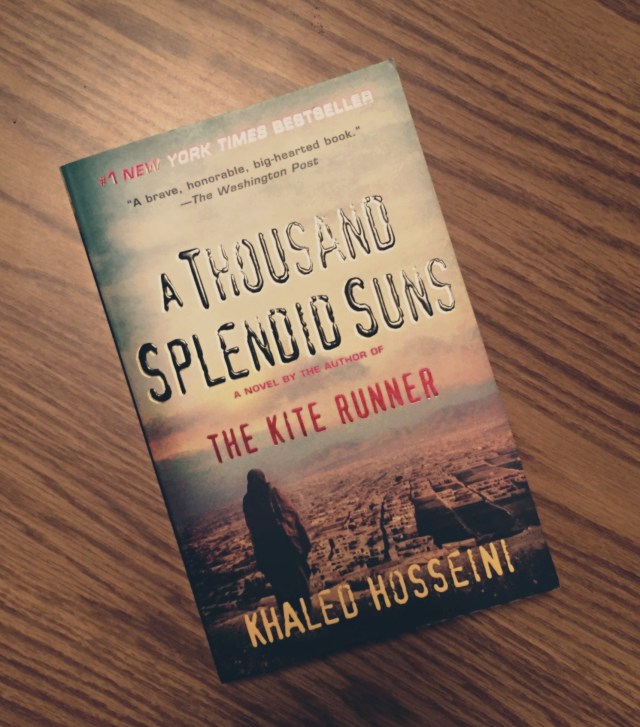
A Thousand Splendid Suns by Khaled Hosseini

IMG_2626

Khaled Hosseini has been on my radar for a while now. For months (years actually) I’ve had A Thousand Splendid Suns, And The Mountains Echoed, and The Kite Runner on my reading list. But my reading list is an evolving one- it’s actually a spreadsheet organized and sorted by fiction/nonfiction, genre, Amazon rating, Goodreads rating, and my own “personal rating.” I know this sounds slightly crazy, but I actually got the idea from a girl that one of my friends went on a date with once. He asked her where she would like to go out for dinner, and she sent him an Excel spreadsheet with a list of restaurants that were sorted and highlighted into a bunch of different categories. I forget if they ever went on a second date, but I was inspired to use a spreadsheet to keep track of all the books I want to read. Basically every time I add a book to my list I enter the Amazon and Goodreads rating and I score the book on a scale of 1 to 5 on how excited I am to read it. Periodically I revise the personal scores based on my interests at the time, like if I’m in the mood for a romance novel or historical fiction or something a little more intellectual. And it’s been so helpful; every time I finish a book I generally know what I’m going to read next.

So Hosseini’s books have been on my list for a while, but until recently they’ve been edged out by my always-changing personal score. Recently, however, I’ve been reading more feminist literature (partly in thanks to Emma Watson, which I’ll discuss in a later post) and I bumped A Thousand Splendid Suns up to the top because at its heart it centers around two females who are brought together through tragedy and circumstance.

And what tragedy. What circumstance. What heart-wrenching lives these women lived. What hope persisted throughout the story despite all the tragedy. A Thousand Splendid Suns made me feel on so many levels, and as I read I kept trying to categorize the relationships and themes to try to put a label on what I was feeling. In the beginning it was about daughters and mothers, and daughters and fathers, then husbands and wives, then parents again, then friends and romance, and I eventually gave up trying to put a label on everything because part of what made this story beautiful was the web of relationships and connectivity of themes and the elegant way in which everything was brought together.

I have so much respect for Hosseini as a writer. It takes real talent to weave a story like this together in such a simple yet profound way. It really is a beautiful story, full of love despite the traumatic setting. It’s always been a dream of mine to be a writer, whether it’s a short story or novel, and this book is proof that I have such a long way to go. I’m not sure if I’ll ever be able to develop a style like this, it’s just amazing to me.

The two main characters in the novel, Mariam and Laila, are women that I would love to meet if they existed in real life. Their capacity to endure, to hope, to protect is beyond anything I can imagine in my own life. I find them inspiring, and I feel for them. I know that this is a work of fiction, but I am sure there are real women who have lived at least parts of this story, and I send good thoughts to whoever and wherever they are.

Other than the various kinds of overwhelming love portrayed in this story, the other main emotion I felt was guilt. A Thousand Splendid Suns spans over three decades of Afghan history, and to be completely honest this was my first exposure to much of that history. Before this book, most of what I knew about Afghanistan was learned from CNN news stories that my mom started watching after 9/11, and I find that embarrassing. It makes me feel incredibly naïve and somewhat uneducated; I keep thinking back to my history classes in high school, wondering if there was a section I blocked out, but I don’t think that’s the case. I don’t think I was ever taught much about Afghanistan, and I never tried to seek it out myself.

This book made me uncomfortably aware of how trivial the things are in my life that I worry about. Compared to others, and especially compared to the women in this story, I’m an incredibly privileged person to be living the life I have. Though I’m generally aware of that fact I felt that it was really thrown at me throughout the book, which I believe is a good thing. I feel more inspired to do some good in the world, to be more aware and educated about what is happening, and most importantly to be truly grateful for everything I have. Mariam and Laila had their worlds turned upside down so many times and in so many different ways, and yet they kept going. They loved, they hoped, they endured, and their unrelenting bravery in the face of hardship makes them some of the best heroines I’ve read about in some time.